iOS setup guide
If you use Expo, follow this guide instead. This guide applies to vanilla React Native apps only.
Link the native module
CocoaPods
- run
pod installin theios/directory to install the module
CocoaPods modular headers
Some dependency combinations may require modular headers. If pod install reports that the Swift pod AppCheckCore depends on GoogleUtilities or RecaptchaInterop, which do not define modules, add both pods to your existing application target in the Podfile:
target 'YourApp' do
  pod 'GoogleUtilities', :modular_headers => true
  pod 'RecaptchaInterop', :modular_headers => true

  # The rest of your existing target configuration
end
Do not add version constraints to these declarations. CocoaPods will select versions compatible with Google Sign-In, and your other dependencies. Projects that already use use_modular_headers! or use_frameworks! do not need these additional declarations.
Swift Package Manager (beta)
Universal Sign In (premium) supports Swift Package Manager (SPM) on iOS in beta. Install the npm package as usual.
SPM dependencies through CocoaPods: CocoaPods remains the default. When RNFirebase 26.x is autolinked on iOS and Firebase SPM is enabled, the package automatically uses SPM for its SDK dependencies. RNFirebase 27+ or failed detection requires an explicit override.
To choose SPM explicitly, add the following before the target blocks in your ios/Podfile, then run pod install:
$RNGoogleSigninDependencyManager = 'spm'
use_frameworks! :linkage => :dynamic
This integration requires React Native 0.75+ and dynamic frameworks. Remove any forced static linkage for RNGoogleSignin or ReactCodegen. If you use Firebase, keep both SDKs on the same dependency manager. To switch back to CocoaPods, set $RNGoogleSigninDependencyManager = 'cocoapods' and also set $RNFirebaseDisableSPM = true if you use RNFirebase.
Full SwiftPM preview: For bare React Native apps using the experimental SwiftPM workflow (tested with React Native 0.87), run:
cd ios
npx react-native spm --deintegrate
Build the app's .xcodeproj. On fresh checkouts or CI, run npx react-native spm from the ios/ directory. Other native dependencies must also support SwiftPM. Continue with the URL scheme and AppDelegate configuration below.
Google project configuration
- Follow this guide to get the configuration information which you need for the next steps.
Firebase Authentication
If you're using Firebase Authentication, download the GoogleService-Info.plist file and place it into your Xcode project.
Xcode configuration
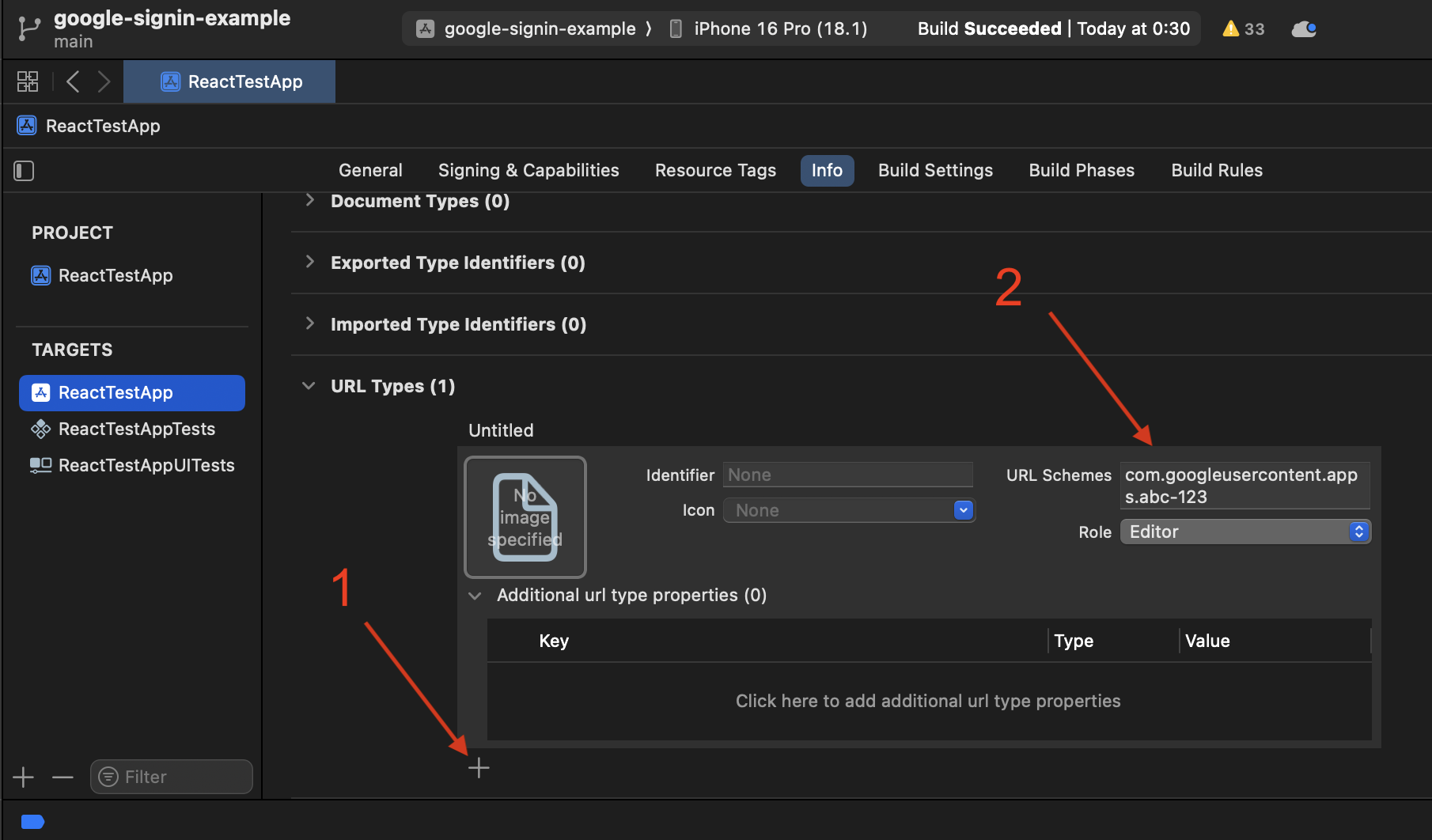
- Configure URL types in the
Infopanel (see screenshot)- add your "iOS URL scheme" (also known as
reversed client id), which can be found in Google Cloud Console under your iOS client ID.
- add your "iOS URL scheme" (also known as
- If you need to support Mac Catalyst, you need to enable the Keychain Sharing capability on each build target. No keychain groups need to be added.
Rebuild the native project
Do not forget to rebuild the native app after the setup is done.
Optional: modify your app to respond to the URL scheme
This is only required if you have multiple listeners for openURL - for instance if you have both Google and Facebook OAuth.
Because only one openURL method can be defined, if you have multiple listeners for openURL, you must combine them into a single function as shown below:
For AppDelegate written in Swift
If your AppDelegate a Swift file (the default in React Native 0.77.0 or higher), you'll need to:
- Add the following import to your project's bridging header file (usually
ios/YourProject-Bridging-Header.h):
// …

// ⬇️ Add this import
#import <GoogleSignIn/GoogleSignIn.h>
- Modify your
AppDelegate.swiftfile:
// …

@main
class AppDelegate: RCTAppDelegate {
  // …

  // ⬇️ Add this method
  override func application(_ app: UIApplication, open url: URL, options: [UIApplication.OpenURLOptionsKey : Any] = [:]) -> Bool {
    // Add any other URL handlers you're using (e.g. Facebook SDK)
    return ApplicationDelegate.shared.application(app, open: url, options: options) ||
           GIDSignIn.sharedInstance.handle(url)
  }

}
For AppDelegate written in Objective-C
For AppDelegate written in Objective-C (the default prior to React Native 0.77), modify your AppDelegate.m file:
#import "AppDelegate.h"
#import <GoogleSignIn/GoogleSignIn.h> // ⬅️ add the header import

// …

@implementation AppDelegate

// …

// ⬇️ Add this method before file @end
- (BOOL)application:(UIApplication *)application openURL:(nonnull NSURL *)url options:(nonnull NSDictionary<NSString *,id> *)options {
  // Add any other URL handlers you're using (e.g. Facebook SDK)
  return [[FBSDKApplicationDelegate sharedInstance] application:application openURL:url options:options] || [GIDSignIn.sharedInstance handleURL:url];
}

@end